

DOE invests $100M in U.S. mining education
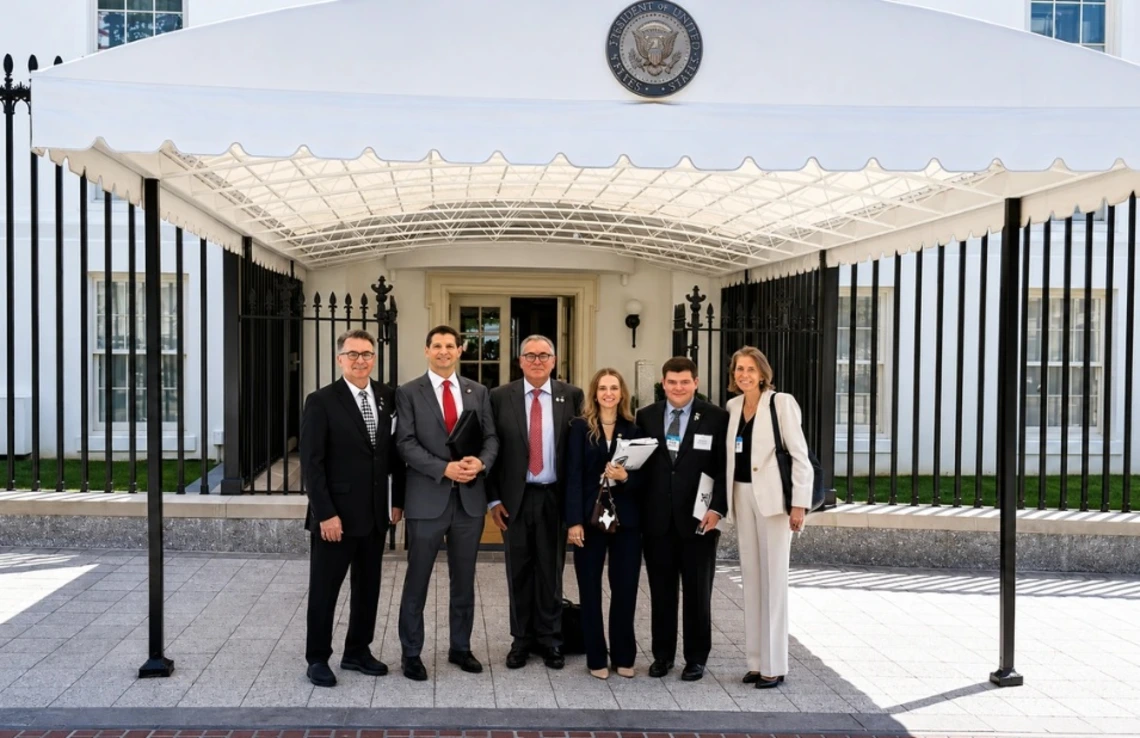
(From left) School of Mining Engineering and Mineral Resources professor Moe Momayez, David Copley, senior director for global supply chains; Tomás Díaz de la Rubia, U of A’s senior vice president for research and partnerships; mining seniors Alexandra Zadro and Esteban Garza, and the school’s executive director Kray Luxbacher join the roundtable announcement for more than $180 million in federal academic grants.
The University of Arizona is positioned to play a key role in a $100 million federal initiative aimed at strengthening mining education and building the nation’s critical minerals workforce.
President Donald Trump announced Aug. 7 that the administration is providing $180 million in grants for mining programs, including a $100 million Department of Energy initiative to strengthen the domestic critical minerals workforce and supply chain.
Representing the U of A at the announcement were Kray Luxbacher, the Gregory H. and Lisa S. Boyce Leadership Chair of Mining and Geological Engineering; mining engineering professor Moe Momayez; mining engineering seniors Alexandra Zadro and Esteban Garza; and Tomás Díaz de la Rubia, U of A senior vice president for research and partnerships.
“In order to achieve American mineral dominance, we really need technology and talent, and your American mining schools are ready to get to work,” Luxbacher said during a roundtable at the Department of State.
The DOE is establishing PROSPECT – Providing Opportunities for Specialized Education in Critical Technologies – with the goal of doubling the number of graduates from the nation’s 14 accredited mining schools.
The investment comes as the mining industry faces a significant workforce challenge. The Society for Mining, Metallurgy and Exploration estimates that more than half of the workforce, nearly 221,000 workers, will retire by 2029.
At the U of A, efforts to prepare the next generation of mining professionals are already underway. Luxbacher has worked with industry and government partners to accelerate training since joining the university in 2022. In April 2025, she organized the inaugural U.S. Mining Summit, bringing academic and industry leaders together to address workforce and other challenges facing the sector.
Those efforts also include MiningWerx, a national hub for mining education and research that incorporates the School’s San Xavier Underground Mining Laboratory in Sahuarita. The facility gives students hands-on experience while also serving as a training ground for industry professionals and a proving ground for new mining technologies.
“If the national agenda is long-term critical mineral security, we have to support the academic institutions training the workforce that makes it happen,” said Momayez, associate head of the School and a senior member of the National Academy of Inventors.
Recent state and federal investments are also expanding San Xavier’s capabilities. The Arizona State Legislature provided $850,000 in 2025 toward a mineral processing facility at the site, followed by $3 million in federal funding in February 2026.
For students like Zadro and Garza, the School’s emphasis on hands-on education and industry connections offers an early introduction to the careers they will enter after graduation.
“Not only are hands-on technical skills learned, but you also see the application of classroom concepts,” said Zadro, vice president of both the U of A chapter of the Society for Mining, Metallurgy and Exploration and the Women in Mining student chapter.
Garza, a second-generation mine employee who is interning with Ames Construction, said those industry connections have already made a difference in his career.
“Being involved with the mining engineering program has its perks,” he said. “It heavily encourages students to connect with industry professionals. It has opened doors for me.”